Faith Ringgold paved the way for many art quilters with her story quilts. See my article in Fiber Focus for more background information on her path.
These are art prints of her work available on Amazon. Please click on the links below the images. The prints are available in many different sizes and price points.
Showing posts with label USA: African American. Show all posts
Showing posts with label USA: African American. Show all posts
Thursday, February 19, 2009
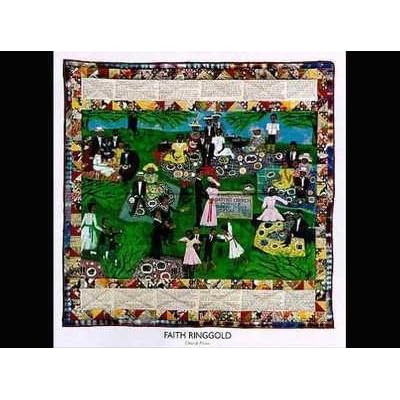

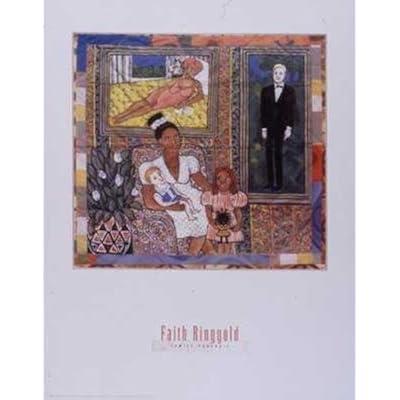


Book: Faith Ringgold, Art Quilter
Faith Ringgold paved the way for many art quilters with her story quilts. See my article in Fiber Focus for more background information on her path.
Click on the links below the images to go to Amazon:
 Talking to Faith Ringgold


Video: Faith Ringgold, Art Quilter
Faith Ringgold paved the way for many art quilters with her story quilts. See my article in Fiber Focus for more background information on her path.
The first two videos are quickies. The third is about an hour and 45 minutes long. It's a slide presentation where Faith talks about her work and at the end there is a question and answer period. Worth watching or listening to if you are interested in her work.
:
The first two videos are quickies. The third is about an hour and 45 minutes long. It's a slide presentation where Faith talks about her work and at the end there is a question and answer period. Worth watching or listening to if you are interested in her work.
:
Tuesday, February 10, 2009
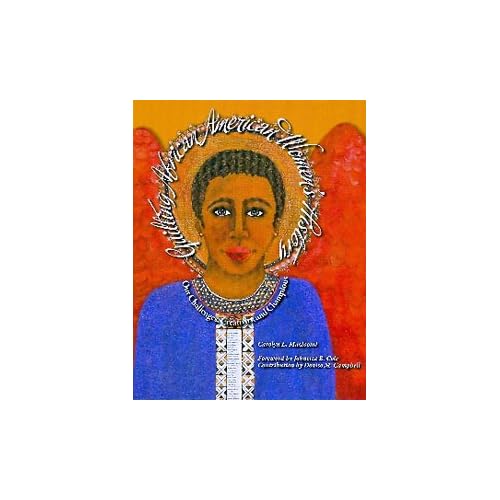
Book: Quilting African American Women's History: Our Challenges, Creativity, and Champions

Product Description
Each of us who has the privilege and the joy of seeing the stunning works in Quilting African American Women's History: Our Challenges, Creativity, and Champions must also listen carefully to what these works of art are saying to us. In the words of quilter Tina Brewer, "Listen closely, focus your eyes deeper." The one hundred-one quilts, created by fifty-three women and men, speak of challenges, creativity, and champions of African American women. For assembling this feast for our eyes and providing a narrative that helps us to clearly hear what these works of art are saying, we are indebted to Dr. Carolyn Mazloomi, the curator of the exhibition. Let us also acknowledge the contribution of Dr. Denise Campbell, Dr. Mazloomi's colleague in the world of quilting and scholarship about this art form. A striking reality about these quilts that is also true of African American women is this: If you have seen one, you have not seen them all. There are "common threads" in these quilts, just as there are in Black women's experiences with racial and gender oppression and in resistance, in efforts to cast us as "the other." There is also great diversity in how each artist unfolds her quilt--as a compelling narrative, as a statement of resistance, as creative expression--indeed as all of this and more. So too are there differences in how we Black women live through our race and gender, sometimes in communion with and sometimes in confrontation with our particular class, age, religion, sexual orientation, physical abilities and disabilities.
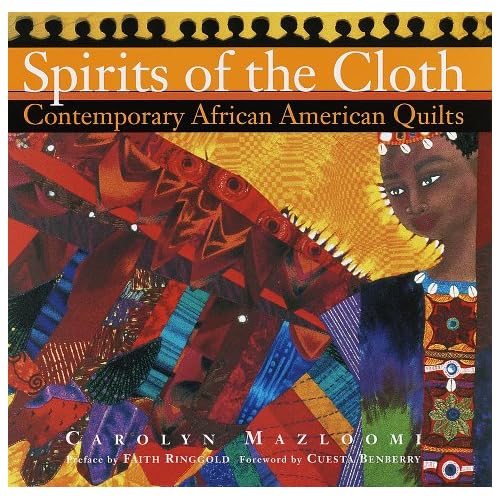
Book, Spirits of the Cloth: Contemporary African American Quilts

Product Description
Featuring 150 color photographs, "Spirits of the Cloth" is one of the first popular books to showcase the work of contemporary African-American quilters.
 Beautiful, work.,
 By A Customer
The book is displayed proudly in my home. I read the book and enjoyed the narratives on each chapter and the comments of each artist. I was very pleased to see the different "twists" and "spins" of each artists work. Looking at the pictures, you can almost touch the colors, textures and the spirit of the work. I've been to several art shows in which some of the featured artists work were on display. I had the opportunity to attend a quilt show in Huntsville AL to hear Yvonne Wells talk about her work and I was extremely pleased that the works of quilt artists are being highlighted in one woman/man shows. The book was long overdue!!!!! Thank you to the artist C. Mazloomi!!!
Book: Accidentally on Purpose: The Aesthetic Management of Irregularities in African Textiles and African-American Quilts
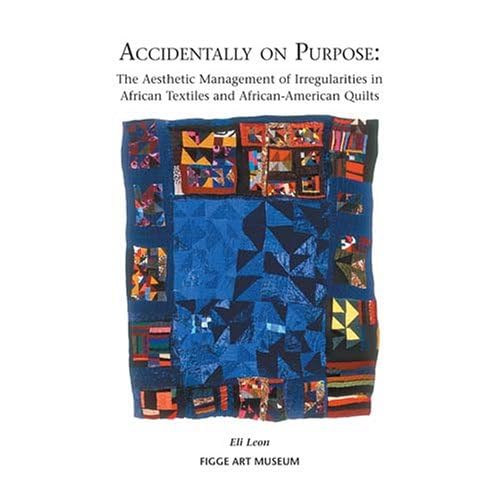

Product Description
This exuberantly illustrated book celebrates the sophistication, vivacity, and significance of improvisational African-American quilts, both as artistic achievements and as expressions of African-American traditions. The knowledge, attitudes, and values carried across the Atlantic by enslaved Africans appear to have informed a quilt-making tradition so powerful that, to this day, it preserves its identity in a special province of African-American quilts. Such "Afro-traditional" quilts are made by people who have no formal art training and who usually do not consider themselves artists; they learned their craft and absorbed its aesthetics by watching and helping their mothers, aunts, and grandmothers who, in turn, learned form previous generations. The resulting--often highly idiosyncratic--quilts call out to be seen as the works of art that they are. The brilliance of this work must be partially credited to a tradition which encourages individual expression and provides a context in which the talents of individual artists can flourish.
Improvisation, pervasive in black African art and familiar as a basic element of many African-American musical forms, is a vital force in this tradition. The artists maintain a generous attitude toward the accidental, embracing innovations that originate beyond the conscious domain. they use approximate measurement and "flexible patterning," in which the design, conceived of as a an invitation to variation, will not repeat, but will materialize in a sequence of visual elaborations.
Afro-traditional attitudes and methods are antithetical to the standard American quiltmaking tradition--practiced by both whites and blacks--in which great value is placed on precise measurement and exact pattern replication. Instead they bear a keen likeness to the improvisatory practices of the textile-makers of Kongo and West Africa, regions from which American slaves were taken. These antipathies and affinities suggest an enduring African influence on the Afro-traditional quilt.
Book: Signs and Symbols: African Images in African American Quilts
Click on the link under the image.


African-American quilts possess two unique qualities: more than any other American visual art, they most fully realize the expressive force of jazz, and they bind together generations of African-American families who have made and cherished quilts. In Signs and Symbols, quilt expert Maude Southwell Wahlman introduces readers to a third powerful force in these quilts: their African-derived meanings, patterns, and iconography. She explores the religious, ritual, philosophical, and aesthetic beliefs that have been retained by descendants of Africans in the New World and demonstrates how these beliefs are represented in their textiles. Now back in print, Signs and Symbols remains the most complete illustrated work on this art form; featuring over 150 high-quality full-color reproductions.
Book: The Soulful Art of African-American Quilts: Nineteen Bold, Improvisational Projects


Product Description
Renowned Kansas City designer and Andover Fabrics artist Sonie Ruffin creates 11 contemporary quilts based on the collection featured in "Bold Improvisation: Searching for African American Quilts - The Heffley Collection." Also included are original designs and patterns for quilts by Sonie, all part of her quest to learn about her family origins and heritage. Sonie's easy-to-follow patterns encourage creativity and simple, quick construction. Each design is paired with Sonie's imaginative stories.
About the Author
For the past four years, Sonie Ruffin, a self-taught fabric artist and story teller, has carved out a niche for herself in the arts community as a fabric artist, fabric designer, and writer. She has lectured and led workshops on her work at numerous museums and galleries, as well as exhibited her work. Sonie's art quilts can be found in permanent collections at galleries, museums, private and corporate collections. Sonie's vibrant quilts are contemporary and bold. They draw from a centuries-old wellspring that explores humanity, through the crux of the African-American experience. She designs from the heart, painting with fabric and embellishing with her needle to reveal universal truths. She is a master at incorporating the boldness of African print fabrics with American print fabrics to create striking designs. She incorporates basic block designs with her own personal designs and invites the viewer to engage in a mental and spiritual conversation with her artwork.
Book: Bold Improvisation: Searching for African-American Quilts - The Heffley Collection
Product Description
This coffee-table art book presents more than 50 bold quilts collected by Scott Heffley dating back 122 years. A tribute to their soulful beauty, the book shows traditional quilts next to their improvisational cousins, as well as African textiles that demonstrate similarities to this American art. Also included are ways to examine quilts, fabric dating, and the importance of recording the history of these quilts. Heffley offers insightful aesthetic observations as well, an outgrowth of his work restoring masterpieces at the Nelson-Atkins Museum of Art in Kansas City.


This coffee-table art book presents more than 50 bold quilts collected by Scott Heffley dating back 122 years. A tribute to their soulful beauty, the book shows traditional quilts next to their improvisational cousins, as well as African textiles that demonstrate similarities to this American art. Also included are ways to examine quilts, fabric dating, and the importance of recording the history of these quilts. Heffley offers insightful aesthetic observations as well, an outgrowth of his work restoring masterpieces at the Nelson-Atkins Museum of Art in Kansas City.
Books for Kids on African American Quilts
Click on the links under the images.
From School Library Journal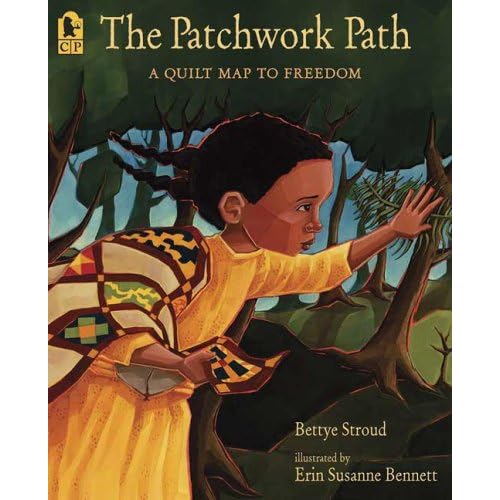

Grade 1-4 - An exciting story about a girl and her father who escape slavery with help from the coded symbols on a quilt. Shortly after Hannah's sister is sold to another plantation, Mama dies, but not before teaching Hannah how to sew, whispering, "…this quilt will show you everything you need to know to run to freedom." Their journey leads them along the Underground Railroad, from their Georgia plantation to a hiding place beneath a church, through pirate tunnels, and eventually to the home of a Quaker family. Finally, they cross Lake Erie into Canada, and the narrative ends on a hopeful note as Hannah makes a new quilt with an empty square for her sister, praying that someday they'll be together again, and free. The first-person narrative flows smoothly and lends immediacy to the dramatic events. The vivid oil paintings are skillfully done, with the characters' expressive faces reflecting their fear and courage, and angular lines echoing the quilt squares. An afterword gives some historical background. Overall, this works well as a story and also as a lesson in African-American history. - Lauralyn Persson, Wilmette Public Library, IL
Copyright © Reed Business Information, a division of Reed Elsevier Inc. All rights reserved. --This text refers to the Hardcover edition.
From Publishers Weekly
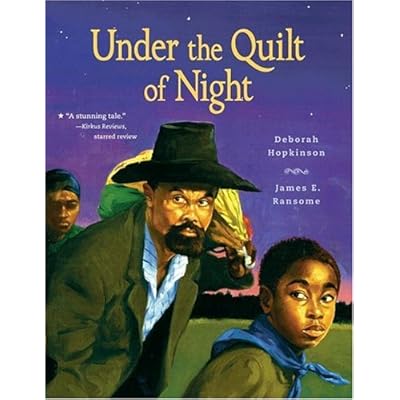

Dramatic oil paintings and compelling verse-like prose combine to portray the harsh yet hopeful experience of travel along the Underground Railroad. Hopkinson and Ransome revisit the theme of their first collaboration, Sweet Clara and the Freedom Quilt. This time readers journey the precarious trail to freedom with a young runaway as she escapes to Canada via clandestine routes and dangerous nighttime treks. The intense opening spread features three panels showing her nameless family running for their lives by the light of the full moon, some shoeless or with only rags on their feet. (Subsequent pages show snarling dogs and overseers in hot pursuit.) The story comes to a formidable climax when they're almost discovered hiding in the back of a wagon. Hopkinson names each segment of the journey ("Running," "Waiting," "Hiding") and her narrative conveys the emotional and physical hardships of the trip ("Fear is so real, it lies here beside me"). The author connects the metaphorical protective quilt of night with folkloric elements (legend has it that quilts with blue center squares indicated safe houses on the Underground Railroad). Ransome fills in the characterizations with portraits that convey a strong familial connection and the kindness of the conductors along the way. This suspenseful story successfully introduces and sheds light on a pivotal chapter in America's history for youngest readers. Ages 5-10.
Copyright 2001 Cahners Business Information, Inc.
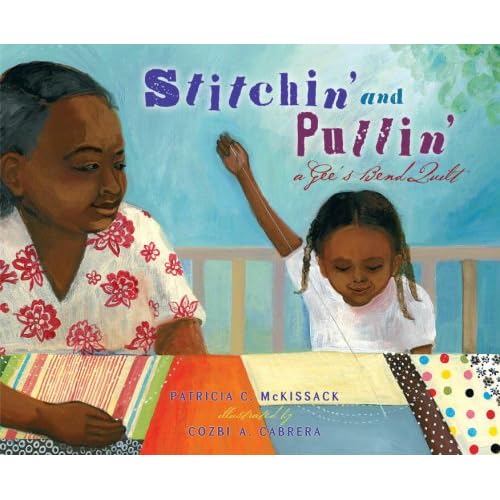

MOTHER AND DAUGHTER, grandmother and granddaughter, aunt and niece, friend and friend. For a hundred years, generations of women from Gee’s Bend have quilted together, sharing stories, trading recipes, singing hymns—all the while stitchin’ and pullin’ thread through cloth. Every day Baby Girl listens, watches, and waits, until she’s called to sit at the quilting frame. Piece by piece, she puzzles her quilt together—telling not just her story, but the story of her family, the story of Gee’s Bend, and the story of her ancestors’ struggle for freedom.
From School Library Journal


Kindergarten-Grade 3-- Clara, a young slave, works as a seamstress and dreams of freedom. Overhearing drovers talk of escaping North enables her to make a patchwork map of the area. When she escapes, she leaves the quilt behind to guide others. Based on a true event, this is a well-written picture book. Ransome's oil paintings, however, are perhaps too smooth and rich for the story they tell. The world depicted is too bright, open, and clean. For example, in the first scene Clara has been put to work in the cotton fields. Supposedly too frail to last long at such work, she is pictured as a slim, serious, yet sturdy girl. The bright yellow sky and the charming smile of the boy with her belie the realities of the back-breaking work. In another scene, young Jack, who has been brought back the day before from running away, looks solemn, but not distressed, and is wearing what appears to be a freshly ironed white shirt. Again, the image distances viewers from the realities of the situation. Clara's escape to Canada, too, is marvelously easy, although she does say, "But not all are as lucky as we were, and most never can come." It is not easy to present the horrors of slavery to young children; thus, even though Ransome's illustrations, and to some extent the text, err on the side of caution, this is an inspiring story worth inclusion in most collections. --Karen James, Louisville Free Public Library, KY
Copyright 1993 Reed Business Information, Inc. --This text refers to the Hardcover edition.
Amazon.com Review


In Cassie's Word Quilt, a young African American girl takes early readers on a remarkable tour of her 1930s-era Harlem home, school, and neighborhood. The tour serves as a vocabulary jaunt, as well. Dozens of objects are clearly labeled; the youngest viewers of this big lap book can point to familiar images as older readers read the captions: "doll," "quilt," "father," "subway," "jump rope." Ringgold's vibrant art captures the excitement of urban life in an era gone by. Gorgeous spreads feature a richly textured quilt motif, with illustrations picking up on the patterns in the squares of fabric bordering the pages. Seldom have we seen a word identification book as artful as Cassie's Word Quilt. Ringgold's other titles include Caldecott Honor Book Tar Beach (on which Cassie's Word Quilt is based), and companion volumes Counting to Tar Beach and Cassie's Colorful Day. (Baby to Preschool) --Emilie Coulter --This text refers to the Hardcover edition.
Product Description


A small African-American girl is overjoyed with the new patchwork quilt her parents have made. As she sleeps, it comes alive, turning into a fantastical dreamscape she must enter in order to find her beloved stuffed dog. An ALA Notable Children's Book. Full color.
Product Description
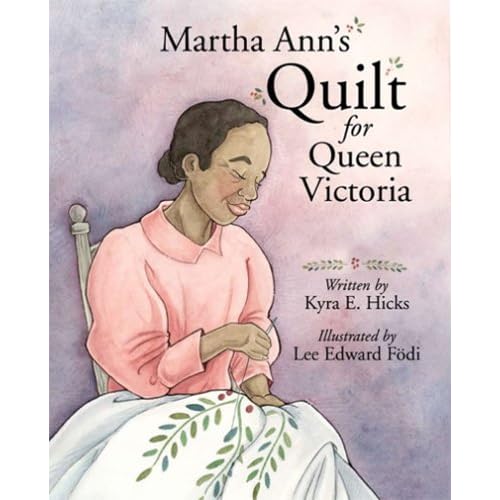

Martha Ann is twelve years old when Papa finally saves enough money to purchase her freedom from slavery. In 1830, the family leaves east Tennessee to begin a new life in Liberia. On market days, Martha Ann watches the British navy patrolling the Liberian coast to stop slave catchers from kidnapping her family and friends and forcing them back into slavery. Martha Ann decides to thank Queen Victoria in person for sending the navy. But first, she must determine how to make the 3,500-mile voyage to England, find a suitable gift for the Queen, and withstand the ridicule of family and friends who learn of her impossible dream. Martha Ann's Quilt for Queen Victoria is the true story of Martha Ann Ricks, an ex-slave who spent fifty years saving spare coins to fulfill her dream of meeting the Queen of England.
From Booklist


*Starred Review* Gr. 3-5. A Show Way is a quilt with secret meanings, and the image works as both history and haunting metaphor in this exquisite picture book. Based on Woodson's own history, the unforgettable story tells of African American women across generations, from slavery and the civil rights movement to the present. The cut-out jacket design is impressive, as is Talbott's mixed-media artwork inside, which extends Woodson's clear poetic narrative with beautiful collages that make use of big triangles, squares, and curves to emphasize portraits and landscapes and show connections and courage. The first double-page spread is of anguished separation when Soonie's great-grandmother is sold "without her ma or pa." Growing up on a plantation in South Carolina, Soonie learns from Big Mama about children "growing up and getting themselves free," and also how to sew quilts with signs that show the way to freedom. Time passes: Soonie's granddaughter, Georgiana, has twin girls who march for freedom in the 1960s. The final glorious spread shows Georgiana's granddaughter, Jacqueline Woodson, laughing at home with her own beloved daughter, Toshi Georgiana, whose picture is embedded in a quilt, connecting her with those who came before. A must for the classroom, this story will move many readers to explore their own family roots; link it to the Booklist interview with Woodson [BKL F 1 05], in which she talks about what she owes to those who came before her. Hazel Rochman
Copyright © American Library Association. All rights reserved
Books on the Gee's Bends Quilts
(Click on the link below the image)


From Publishers Weekly
Gee's Bend, Alabama, is a hamlet of 750 residents, most of whom are the descendants of slaves from the former Pettway plantation (and bear the surname Pettway), who during the New Deal purchased farms from the government. For much of the last century, the women of Gee's Bend have produced some of the most striking examples of American vernacular art, sharing them among the community and storing them within their homes. Aside from a brief stint of notoriety during a Civil Rights-era "Freedom Quilting Bee," this catalogue, accompanying an exhibit at the Museum of Fine Arts, Houston and New York's Whitney Museum of American Art, marks the work's entry into the public sphere. Founded by art collector William Arnett and Jane Fonda, the nonprofit Tinwood Alliance devotes itself to the cultural legacy of Gee's Bend, here offering 195 illustrations (162 in full color) documenting the quilts and the lives of many of their makers. The oversize format allows the many full-page reproductions to approximate the sensation of a large quilt spread on the page; the many "Housetop" quilts, with arresting geometric patterns and terrific color sense, speak for themselves. The book and exhibition make an important contribution to American cultural history.
Copyright 2002 Reed Business Information, Inc.
From Booklist
At first glance, the quilts of this collection are simply stunning--rich colors in surprising combinations, refreshingly irregular geometric compositions with hardly a right angle among them, big blocks whose seams virtually vibrate with energy. Then consider the history of the community they come from, and these quilts become a stunning illustration of resourcefulness. Gee's Bend, a remote peninsula on the Alabama River, is an isolated place, one that has known extreme poverty and struggle. Its quilters of the twentieth century are showcased here. Three insightful essays on the community's history and its quilting tradition make up for a self-consciously scholarly introduction. The words of the quilters themselves follow. Brief accounts of their lives and thoughts on quilting accompany full-page photographs of their accomplishments. This large-format hardcover, and coinciding exhibition at the Whitney Museum of American Art, should guarantee the women of Gee's Bend the prominence they deserve in the story of the American quilt. Marya Graff
Copyright © American Library Association. All rights reserved


Product Description
In 2002, Gee’s Bend burst into international prominence through the success of Tinwood’s Quilts of Gee’s Bend exhibition and book, which revealed an important and previously invisible art tradition from the African American South. Critics and popular audiences alike marveled at these quilts that combined the best of contemporary design with a deeply rooted ethnic heritage and compelling human stories about the women. Gee's Bend: The Architecture of the Quilt is a major book and museum exhibition that will premiere at the Museum of Fine Arts, Houston (MFAH), in June 2006 before traveling to seven American museums through 2008. The book's 330 color illustrations and insightful text bring home the exciting experience to readers while displaying all the cultural heritage and craftsmanship that have gone into these remarkable quilts.
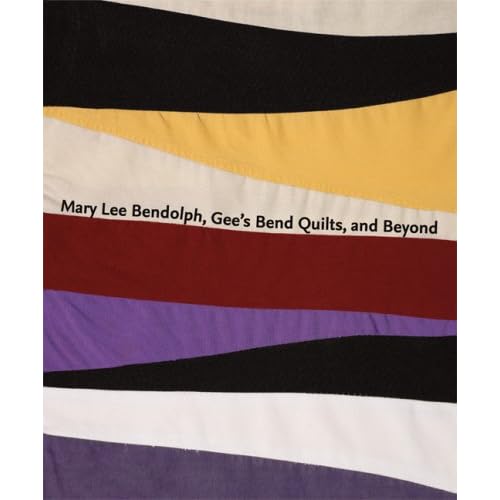 Mary Lee Bendolph, Gee's Bend Quilts, and Beyond
Product Description
Mary Lee Bendolph’s extraordinary patchworks garnered national attention when they were featured among the works of other quiltmakers from her tiny, predominately African American community in the 2002 blockbuster exhibition and book, The Quilts of Gee’s Bend. This beautiful book examines Bendolph’s inspiration, creative process, and individual genius, as well as her profound connection to the cultural practices and expressive traditions out of which her work arises. It studies her artistic relationships with other artists — her mother, Aolar Mosely; her daughter, Essie Bendolph Pettway; her daughter-in-law Louisiana P. Bendolph; and two self-taught Alabama artists, Lonnie Holley and Thornton Dial. Bendolph’s conception of herself as an artist is intimately connected to all of these aesthetic relationships, which together provide contexts for understanding the full scope and power of her work. As they intersect in Bendolph’s life and art, these deep social and aesthetic networks give rise to new pathways of artistic influence and exchange, to a body of work that is a powerful mixture of communal and individual creative energies.
Product Description
Since the 19th century, the women of Gee’s Bend in southern Alabama have created stunning, vibrant quilts. Beautifully illustrated with 350 color illustrations, 30 black-and-white illustrations, and charts, Gee’s Bend to Rehoboth is being·released in conjunction with a national exhibition tour including The Museum of Fine Art, Houston, and the Whitney Museum of American Art.


Product Description
Since the 19th century, the women of Gee’s Bend in southern Alabama have created stunning, vibrant quilts. Beautifully illustrated with 350 color illustrations, 30 black-and-white illustrations, and charts, Gee’s Bend to Rehoboth is being·released in conjunction with a national exhibition tour including The Museum of Fine Art, Houston, and the Whitney Museum of American Art.
Subscribe to:
Posts (Atom)