Showing posts with label Book: First Nations. Show all posts

Thursday, February 5, 2009

Traditional Native American Arts and Activities


Product Description
Did you ever wonder what life might be like in a Native American village? What would you eat, and how would you pass the long winter nights? In this book, you can find out by cooking and eating traditional Catawba roasted corn, making your own Lakota beaded wristband, or creating a decorative Zuni water jar. At the same time, you’ll be exploring indigenous cultures from the Inuit of the Arctic to the Tohono O’odam of the Sonoran Desert. You’ll be amazed and delighted by the wealth of fascinating facts and exciting things to do and make in Traditional Native American Arts and Activities. Jam-packed with fun and easy-to-follow projects, recipes, and games, this captivating book explores what makes the heritage of Native Americans so unique and wonderful. Where else can you learn how to sew a Tlingit button blanket, stir up a yummy Yupik wild raspberry dessert, or make a coaster using a traditional Seminole patchwork design? Encounter the stories and customs of the early North Americans, and of their descendants today, and have a great time doing it!

The Inca: Activities and Crafts from a Mysterious Land


Product Description
Discover the ancient Inca culture with these fun games and activities!

Make an Inca tunic. Prepare a quinoa snack. Create a royal headdress. You’ll have a great time exploring the cultural traditions of these fascinating people as you learn to write an Inca poem, sculpt your own clay portrait in the shape of an Inca jug, and test your bluffing skills as you play Perudo.

This book is filled with activities and projects that will show you how the ancient Inca people lived and played, as well as how they managed to create an empire that extended nearly 3,000 miles! You’ll learn about the bravery of Inca warriors as you construct a war shield. You’ll discover how the Inca created beautiful music with panpipes and dance bells–and you’ll make them yourself! You’ll get to prepare a tasty Inca dish called Andean stew. Plus, you’ll find lots of amazing Inca facts on topics ranging from history and religion to language, metalworking, and art. So get ready for lots of fun as you discover the ancient secrets of The Inca.

Wednesday, February 4, 2009

Navajo Weaving Way: The Path from Fleece to Rug


From Library Journal
The publisher has performed a real service in making available the work of Bennett, whose books on Navajo weaving and tradition have been out of print for some time. In 1968, as young woman, Bennett moved to the Navajo reservation in Arizona planning a two-year stay to learn traditional Navajo weaving and spinning techniques. She remained for eight years, learned to weave under the tutelage of Tiana Bighorse, and began a life-long fascination with the Navajo way of life. This volume is a reworking of Bennett's Working with the Wool (1971), The Weaver's Pathway (1974), and Designing with the Wool (1979), combining material from these earlier books with new information on Navajo spinning and dyeing techniques. Recommended for scholarly decorative arts holdings as well as public how-to collections.

Copyright 1997 Reed Business Information, Inc.

Product Description
Navajo Weaving Way is a compilation of Nol Bennett's earlier, out-of-print books on Navajo rug-weaving traditions: Working with the Wool, Designing with the Wool, and The Weaver's Pathway. This book augments the information in Bennett's previous works with all-new chapters on spinning, carding, and dyeing techniques. Illustrations include photographs by John Running of Navajo women carding, spinning, and weaving, along with detailed line drawings depicting specific techniques.

Weaving New Worlds: Southeastern Cherokee Women and Their Basketry


From Library Journal

Far more than a survey of Eastern Cherokee women basket makers, this is an in-depth study of tribal women's history, the ecological and social obstacles facing weavers and other artisans, and the pressures of society, mainly tourism, on their craft. Hill, an independent scholar with a doctorate in American studies, has done a staggering amount of research to produce possibly the definitive historical study of Cherokee women and their basketry. Indeed, the baskets often take second place to the powerful quotes, representing all periods from the time of white contact to the present, especially about the strength it took to remain hidden in the mountains on their own land when most of the tribe was removed to Oklahoma. But the baskets are the attraction here: a variety of materials (primarily cane, oak, honeysuckle, and maple) are used through the centuries in a variety and quality that remains amazing. More recently, ornamentation and novelty have replaced utility, but the baskets still have the tautness and beauty of the old forms, and the same designs persist. For more scholarly Native American collections. Gay Neale, Southside Virginia Community Coll. Lib., Alberta

Copyright 1997 Reed Business Information, Inc.

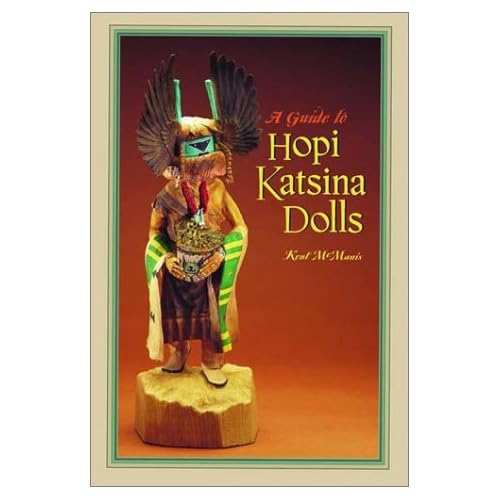
A Guide to Hopi Katsina Dolls


Product Description

Hopi katsinam and the dolls that represent them have fascinated Indian arts trader and author Kent McManis since he was a little boy. In A Guide to Hopi Katsina Dolls, McManis shows how the eternal spirit of the katsinam manifests itself in the works of some of the most skilled and inspired Hopi carvers working today.

For the Hopi-a communal farming people who reside in stone and adobe villages on and near three Mesas in northeastern Arizona-everything in life is imbued with the sacred. The Hopi attribute their very survival as a people to the katsinam, inhabitants of the spiritual realm who convey prayers to the gods and respond with blessings in the form of rain, bountiful harvests, and plentiful game.

In A Guide to Hopi Katsina Dolls, more than seventy of the most prominent and intriguing katsinam who appear during the Hopi ceremonial year are described and depicted in full color photographs of both contemporary and historic katsina dolls.

Wednesday, January 14, 2009