Showing posts with label Book:Textile. Show all posts

Thursday, February 5, 2009

World Textiles: A Visual Guide to Traditional Techniques


Product Description
A complete guide to the whole range of traditional handmade textiles from all corners of the globe.

The history of the world can be read in textiles: the rise of civilizations and the fall of empires are woven into their warp and weft along with the great stories of conquest, religion, and trade. The legacy of textile design, form, and pattern that has resulted from this global endowment can be seen here in all its spectacular richness.

Eight sections cover every aspect of materials and techniques, each giving a succinct summary of characteristics, production, and geographical distribution, accompanied by hundreds of color illustrations and drawings. Nonloom and loom-woven textiles, painted and printed, dyed, sewn, embroidered, and embellished techniques are all covered, as well as the materials themselves.

From simple—the clothes made of skin or hide in prehistoric times—to complex—materials elaborately embellished with tassels—world textiles are both beautiful and beguiling. This unrivaled guide is completed by a glossary, further reading, and information on collections open to the public. 778 illustrations, 551 in color.
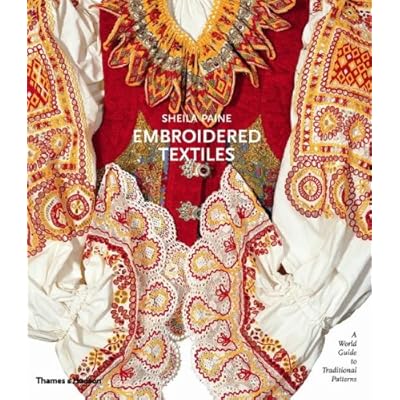
Embroidered Textiles: A World Guide to Traditional Patterns


Product Description
The only worldwide survey of embroidered textiles: a remarkable visual panorama.

Embroidery has been practiced for thousands of years, and the variety is astonishing: gold-embroidered Chinese court insignia, landscape-worked Japanese kimonos, Sumatran sarongs, Indian saris, Afghan chain-stitched purses, Turkish napkin borders, Ghanaian patchwork banners, Egyptian head shawls, Moroccan cushion covers, Hungarian sheepskin jerkins, Slovakian bed curtains, German folk dress, Dutch bonnets, Breton coifs, Sicilian ecclesiastical cloths, Spanish sleeves, North American Indian quillwork pouches, Mexican blouses, Panamanian molas, Peruvian Nasca textiles, and more.

The book is organized into four main sections, covering every aspect of embroidered textiles:
•Guide to Identification: the key fabrics, materials, stitches, motifs, and styles;
• The Decorative Power of Cult: recurrent mythological symbols, including Great Goddess figures, Trees of Life, and symbols of the Hunt;
• Religion and Its Patterns: the main symbols of all the major religious and spiritual systems;
• The Magic of Embroidery: protective and strengthening devices rooted in ancient beliefs and superstitions.

There are 500 illustrations (over 360 in color), including specially taken color photographs, maps, line drawings, and a dictionary of stitches. Complete with a glossary, a guide to textile collections around the world, and advice on collecting and conserving textiles, this comprehensive survey, now in an enhanced format and completely revised, will be invaluable to anyone interested in fashion, textiles, crafts, and design.

About the Author
Sheila Paine is a world expert on tribal societies and textiles.

Wednesday, February 4, 2009

Living Fabric: Weaving Among The Nomads Of Ladakh Himalaya


Product Description
This is the first study of the tradition of weaving among the nomadic pastoralists of Rupshu, in eastern Ladakh. Weaving touches all aspects of life in Rupshu, where both women and men weave, each on a different type of loom. Local narrative states that the craft of weaving was bestowed upon Rupshu by the gods, and thus all feats related to it have a close connection to the sublime. This book documents and analyses the ways in which fibers, weaving, and textiles are symbolized, constructed, and experienced in Rupshu where themes such as gender, kinship, hierarchical and spatial relations find ready expression through the design and making of cloth. Through her work the author traces the relationship between livestock, weaving, social and symbolic structures in order to understand the multitude of contexts within which wool-oriented activities exist. Richly illustrated, this book will appeal to those with an interest in textiles, nomads, gender studies, and the Himalaya.

About the Author
Monisha Ahmed has been visiting and writing about the Himalayan region of Ladakh since 1987. She is co-founder of the Ladakh Arts and Multi-cultural Outreach Trust, a non-government organization that works with the arts in Ladakh and is in the process of establishing a locally based arts resource center in Leh.

Traditional Textiles of the Andes: Life and Cloth in the Highlands


Product Description
The Andean Mountains are home to a rich heritage of textile design and weaving. In particular, cloth has traditionally been the most significant art form and cultural vehicle of the Aymara and Quechua peoples. Published in association with the Fine Arts Museums of San Francisco, this book features eighteenth-, nineteenth-, and twentieth-century indigenous textiles woven by the Aymara and Quechua. The elaborately patterned pieces are all drawn from the previously unpublished Jeffrey Appleby Collection and include everyday and ceremonial textiles of all types: ponchos, skirts, belts, hats, and slings. The accompanying essays by Lynn Ann Meisch, Amy Oakland Rodman, Ed Franquemont, and Margot Blum Schevill address such topics as the long history of fibers, dyes, imagery, and textile use in the region; and the effects of urbanization and westernization on traditional Andean weaving.

Woven Stories: Andean Textiles and Rituals


Product Description

The Quechua people of southern Peru are both agriculturalists and herders who maintain large herds of alpacas and llamas. But they are also weavers, and it is through weaving that their cultural traditions are passed down over the generations. Owing to the region’s isolation, the textile symbols, forms of clothing, and technical processes remain strongly linked to the people’s environment and their ancestors.

Heckman’s photographs convey the warmth and vitality of the Quechua people and illustrate how the land is intricately woven into their lives and their beliefs.

Quechua weavers in the mountainous regions near Cuzco, Peru, produce certain textile forms and designs not found elsewhere in the Andes. Their textiles are a legacy of their Andean ancestors. Andrea Heckman has devoted more than twenty years to documenting and analyzing the ways Andean beliefs persist over time in visual symbols embedded in textiles and portrayed in rituals. Her primary focus is the area around the sacred peak of Ausangate, in southern Peru, some eighty-five miles southeast of the former Inca capital of Cuzco.

The core of this book is an ethnographic account of the textiles and their place in daily life that considers how the form and content of Quechua patterns and designs pass stories down and preserve traditions as well as how the ritual use of textiles sustain a sense of community and a connection to the past. Heckman concludes by assessing the influences of the global economy on indigenous Quechua, who maintain their own worldview within the larger fabric of twentieth-century cultural values and hence have survived everything from Latin American militarism to a tidal wave of post-modern change.

Wednesday, January 14, 2009