Showing posts with label Book: Symbolism. Show all posts

Tuesday, February 10, 2009

Book: Signs and Symbols: African Images in African American Quilts

Click on the link under the image.


African-American quilts possess two unique qualities: more than any other American visual art, they most fully realize the expressive force of jazz, and they bind together generations of African-American families who have made and cherished quilts. In Signs and Symbols, quilt expert Maude Southwell Wahlman introduces readers to a third powerful force in these quilts: their African-derived meanings, patterns, and iconography. She explores the religious, ritual, philosophical, and aesthetic beliefs that have been retained by descendants of Africans in the New World and demonstrates how these beliefs are represented in their textiles. Now back in print, Signs and Symbols remains the most complete illustrated work on this art form; featuring over 150 high-quality full-color reproductions.

Thursday, February 5, 2009

Celtic and Old Norse Designs (Dover Pictorial Archive Series)


Product Description
For artists, designers and craftworkers—125 copyright-free designs depicting birds, human figures, mythological creatures, interwoven patterns and more, all meticulously adapted from centuries-old rune stones, religious symbols, furniture, manuscripts, sword hilts, cooking utensils, and other artifacts. A wealth of dramatic ornamentation in a practical and inexpensive sourcebook.

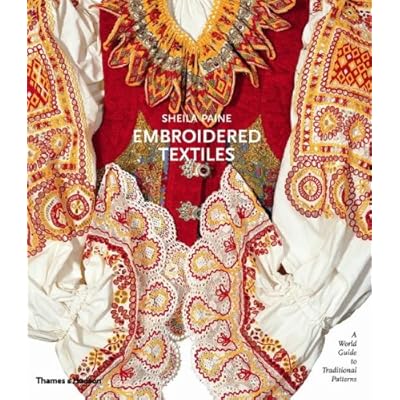
Embroidered Textiles: A World Guide to Traditional Patterns


Product Description
The only worldwide survey of embroidered textiles: a remarkable visual panorama.

Embroidery has been practiced for thousands of years, and the variety is astonishing: gold-embroidered Chinese court insignia, landscape-worked Japanese kimonos, Sumatran sarongs, Indian saris, Afghan chain-stitched purses, Turkish napkin borders, Ghanaian patchwork banners, Egyptian head shawls, Moroccan cushion covers, Hungarian sheepskin jerkins, Slovakian bed curtains, German folk dress, Dutch bonnets, Breton coifs, Sicilian ecclesiastical cloths, Spanish sleeves, North American Indian quillwork pouches, Mexican blouses, Panamanian molas, Peruvian Nasca textiles, and more.

The book is organized into four main sections, covering every aspect of embroidered textiles:
•Guide to Identification: the key fabrics, materials, stitches, motifs, and styles;
• The Decorative Power of Cult: recurrent mythological symbols, including Great Goddess figures, Trees of Life, and symbols of the Hunt;
• Religion and Its Patterns: the main symbols of all the major religious and spiritual systems;
• The Magic of Embroidery: protective and strengthening devices rooted in ancient beliefs and superstitions.

There are 500 illustrations (over 360 in color), including specially taken color photographs, maps, line drawings, and a dictionary of stitches. Complete with a glossary, a guide to textile collections around the world, and advice on collecting and conserving textiles, this comprehensive survey, now in an enhanced format and completely revised, will be invaluable to anyone interested in fashion, textiles, crafts, and design.

About the Author
Sheila Paine is a world expert on tribal societies and textiles.

Wednesday, February 4, 2009

African Elegance


Product Description

In Africa, beaded ornaments may mark an individual's progress through life, and intricate woven fabrics chronicle the deeds of warriors and kings. "African Elegance" delves into the ways in which such traditional objects as masks, jewelry, and wooden vessels are used in contemporary African society. From the vibrant, carved coffins of Ghana and the treasures made by sixteenth-century Benin metal smiths to the sleek objects in serpentine crafted by the Shona sculptors of Zimbabwe, "African Elegance" dynamically explores how native Africans display themselves, exchange messages, and tell stories through craft. An object as beautiful as the work it celebrates, "African Elegance" is a stunningly photographed chronicle of art and personal adornment.

Hidden in Plain View: A Secret Story of Quilts and the Underground Railroad


Amazon.com Review
When quiltmaker Ozella McDaniels told Jacqueline Tobin of the Underground Railroad Quilt Code, it sparked Tobin to place the tale within the history of the Underground Railroad. Hidden in Plain View documents Tobin and Raymond Dobard's journey of discovery, linking Ozella's stories to other forms of hidden communication from history books, codes, and songs. Each quilt, which could be laid out to air without arousing suspicion, gave slaves directions for their escape. Ozella tells Tobin how quilt patterns like the wagon wheel, log cabin, and shoofly signaled slaves how and when to prepare for their journey. Stitching and knots created maps, showing slaves the way to safety.

The authors construct history around Ozella's story, finding evidence in cultural artifacts like slave narratives, folk songs, spirituals, documented slave codes, and children's' stories. Tobin and Dobard write that "from the time of slavery until today, secrecy was one way the black community could protect itself. If the white man didn't know what was going on, he couldn't seek reprisals." Hidden in Plain View is a multilayered and unique piece of scholarship, oral history, and cultural exploration that reveals slaves as deliberate agents in their own quest for freedom even as it shows that history can sometimes be found where you least expect it. --Amy Wan

Masks: Faces of Culture


From Library Journal

Companion to an exhibition currently at the Saint Louis Art Museum, this volume is exactly what it claims to be: a survey of the phenomenon of masks. On the surface, this may seem to be a simple undertaking, but it is not. Mask-making is a deeply human endeavor fraught with meanings. Starting with prehistory and extending to the present age, this book thoroughly examines the many reasons for making and wearing masks. Rites of passage, warfare, and drama are all addressed, from the earliest known examples in Egypt, Australia, and MesoAmerica to football helmets and Star Wars characters in the present day. Six fascinating essays, including contributions by John Emigh (theater, Brown Univ.) and Lesley Ferris (theater, Ohio State Univ.), are interconnected by stunning illustrations. This is definitely the book for anyone wishing to sample the subject. Highly recommended. A Susan M. Olcott, Columbus, OH

Copyright 1999 Reed Business Information, Inc.

1000 Symbols: What Shapes Mean in Art and Myth


From Library Journal

The authors, both British art historians, are joined by 12 other experts in this field to present an amazing array of multicultural interpretations of the world as condensed into symbolic images. They define a symbol as "something that a particular culture considers to mean something else." Each entry features a blue line drawing of the symbol in a generalized pictographic style. Although the quantity of images could have been overwhelming, the symbols are extremely well organized into numbered columns that correspond with the alphabetical front index, or "symbol finder." This index is invaluable because the text itself is composed of eight thematic chapters, among them "Heaven and Earth," "Characters and People," and "Objects and Artifacts." Pertinent cultural meanings for the symbols are refreshingly worldwide, covering Africa, Europe, the Middle East, the Far East, the Americas, and the Pacific.

Many of the connotations are religious in nature, with references ranging from Aztec beliefs to Mesopotamian mythology to major contemporary religions. The editors encourage readers to "dip" into the book and then follow the threads of capitalized cross references. After doing so, one will never think the same way again about eyes, rabbits, roses, swastikas, the color white, and 995 other things. Even libraries with standard reference works like James Hall's Illustrated Dictionary of Symbols in Eastern and Western Art will want to add this one, not just because of its larger number of symbols but for its greater global coverage. Enthusiastically recommended for all public libraries.
Anne Marie Lane, American Heritage Ctr., Univ. of Wyoming, Laramie

Copyright 2002 Reed Business Information, Inc.